
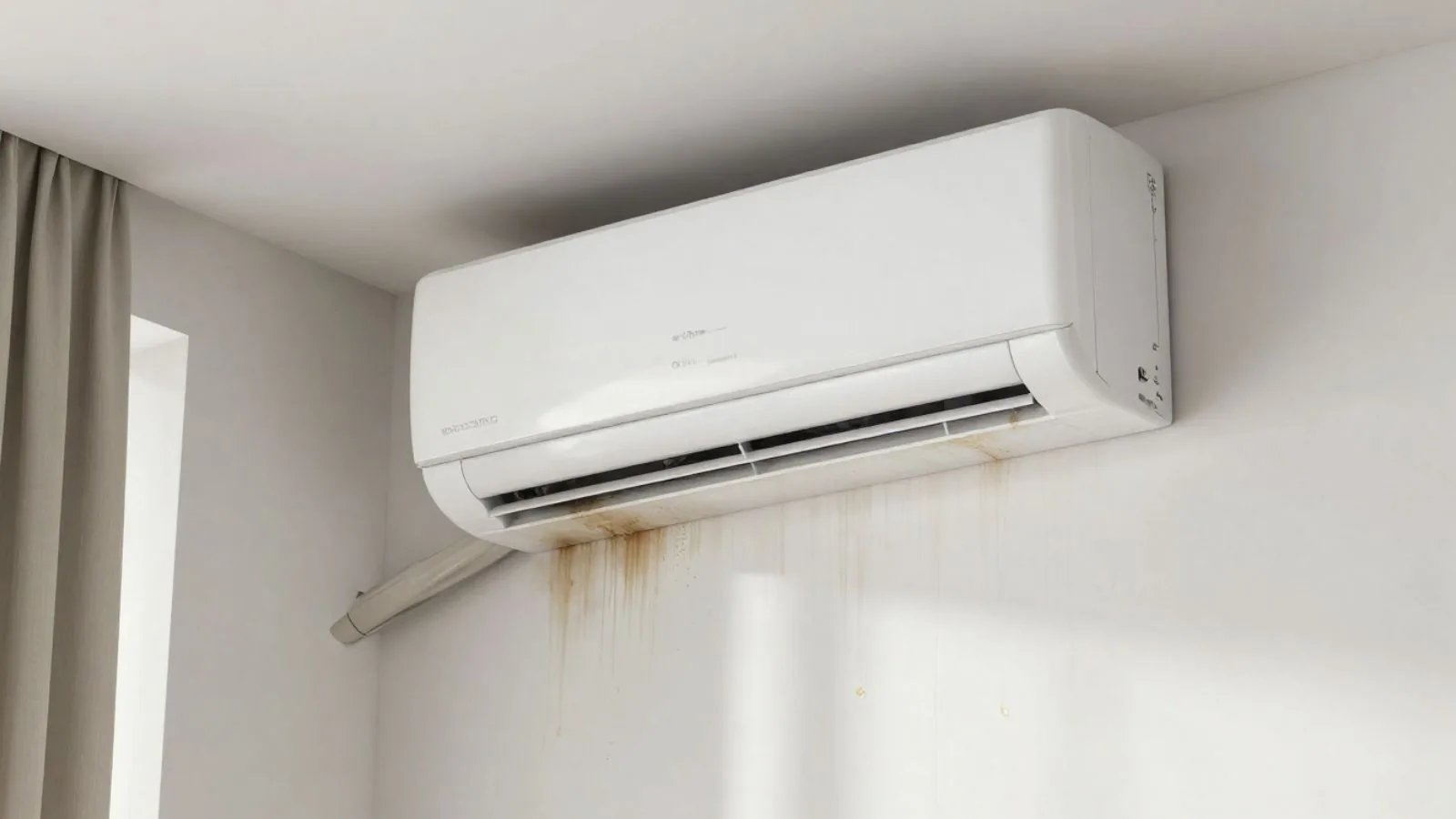
What an AC leak does inside a house
Cooling equipment pulls moisture out of the air, and that condensate leaves through a drain line. When the line clogs or a drain pan rusts through, the water goes where gravity sends it, usually into attic insulation, a closet floor or the ceiling below an air handler. The damage builds slowly, which is why the first sign is often a stain or musty smell.
This page covers the water damage left by AC and HVAC leaks in East Haven, CT. Repairing the equipment is an HVAC technician's job.
Safety first
Turn the air conditioner or furnace off at the thermostat before you touch anything near the air handler. Keep wet insulation and ceiling tiles away from electrical parts, and stay off a ladder under a sagging ceiling.
Stop the leak
- Turn the AC off at the thermostat and the breaker so the unit stops producing condensate.
- Look for standing water in the drain pan or at the unit and soak it up if you can reach it safely.
- Place a container under any drips and move belongings out of the way.
- Photograph the stain, the unit and the pan.
- Call an HVAC technician for the equipment and (833) 521-1033 for the water damage.
Why AC leaks are easy to miss
A condensate leak in an attic or closet can run for days or weeks. Insulation traps the moisture, and drywall above a ceiling stays wet without any obvious sign until a stain appears. Because the water is condensate, it is usually clean at first, but it can pick up dust and biological growth in the pan and line.
We use moisture meters and thermal imaging to follow the water and find wet insulation. If the water has reached the ceiling below, the ceiling water damage page covers that part.
Where AC leaks show up
| Equipment | Typical failure | Where you notice it |
|---|---|---|
| Attic air handler | Clogged drain line or rusted pan. | Ceiling stain below. |
| Closet or basement air handler. | Float switch fails or line backs up. | Floor and wall base. |
| Ductless mini-split | Blocked drain or tilted unit. | Wall stain below the indoor unit. |
| Window or portable unit | Tilt, full tank or blocked drain. | Floor and window sill. |
Condensate lines, pans and float switches
An air handler produces condensate whenever it cools. The water drains through a trap and line to a floor drain, a sink or the outdoors, and a backup pan catches overflow. A float switch is supposed to shut the unit off if the pan fills. When the line clogs with algae and debris, and the switch fails or is missing, the pan overflows, and the water goes to the ceiling or floor below.
A technician can clear the line, test the switch and check the pan. Our part begins once water has left the system, which means finding it in insulation, framing and drywall and drying it.
Humidity, attic insulation and mold
Attic air handlers sit in a hot, enclosed space, and the insulation around them can stay damp long after a leak stops. Damp insulation against wood framing and drywall is exactly the combination that supports mold. That is why a small stain can mean a larger wet area, and why moisture mapping matters before repainting a stain.
If mold is found, the process follows S520 practice and is covered on the mold remediation page.
Stain below the air handler? Get the wet insulation checked.
Call (833) 521-1033Signs of AC leak water damage
- A stain on the ceiling that grows when the AC runs.
- Dripping at a ceiling vent or around a return grille.
- Damp insulation or a musty odor near the air handler.
- Rust on the drain pan or a standing-water float switch.
- Peeling paint on a wall near a mini-split.
What affects cost
Time of leak
Weeks of slow wetting soak more insulation.
Insulation type
Fiberglass and cellulose react differently to water.
Drywall affected
Ceilings may need partial removal.
Access
Attic work needs safe access and ventilation.
Equipment repair
HVAC repair is separate from water damage work.
The price is explained before work starts. Call (833) 521-1033 with your questions.
Insurance for AC leaks
Sudden discharge is often covered, but long-term slow leaks and maintenance issues often are not. Read the policy or ask your insurer, and keep service records for the unit. The repair is an HVAC job, and East Haven lists heating and air conditioning equipment installation among work needing a permit.
Questions about ac leak water damage in East Haven
Do you handle AC leak water damage after hours in East Haven?
Yes. The line is open 24/7, though AC leaks are often slower than a pipe burst. Turn the system off and call (833) 521-1033.
Is AC condensate clean water?
It begins as clean water, but pan and line residue can add contaminants. We treat the area and dry it to target readings.
Can I just clear the drain line myself?
You can often clear a blocked line with a wet vacuum at the outdoor end, but check with an HVAC technician. We handle the water damage, not the equipment.
Will the ceiling stain go away?
Once dry and sealed, the stain can be primed and repainted. If the ceiling is sagging, drywall may need replacement.
Do mini-splits leak as well?
Yes. A blocked drain or tilted indoor unit can leak down the wall. The fix is the drain line, and the wall is dried afterward.
Where we work
Our crews take ac leak water damage calls in East Haven, New Haven and Woodbridge. If you are in Ansonia, West Haven and Hamden, describe where you are and we will answer straight.
Further reading on ac leak water damage: National Weather Service New Haven and Long Island office, Connecticut Department of Public Health, Town of East Haven. Industry practice for water work follows the ANSI/IICRC S500 standard and for mold work the S520 standard.
Water from an air handler? Call to get the area dried.
Call (833) 521-1033